A few things I’ve been building

Selected projects.

A closer look at the tools I have built and the media work I run: the problem, the process, and what I learned.

AI / Product In development

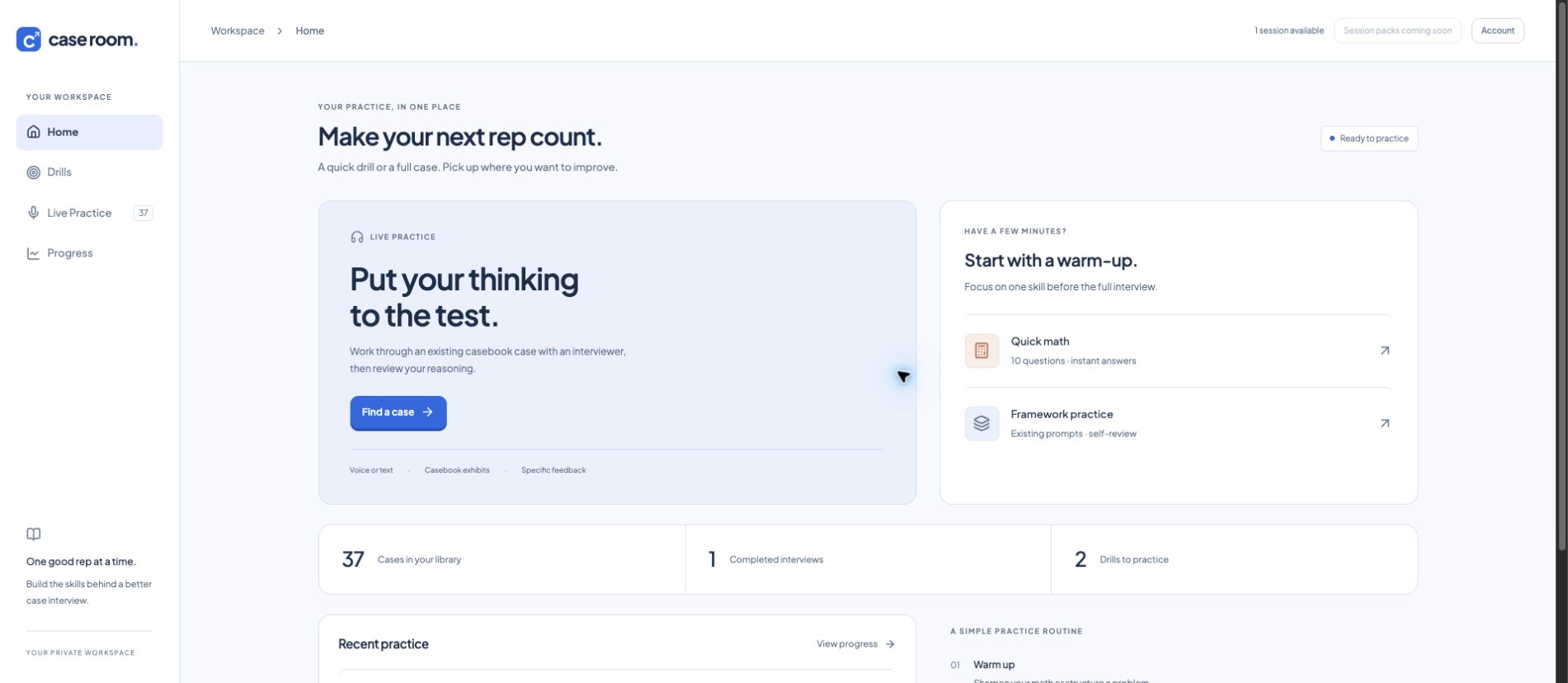
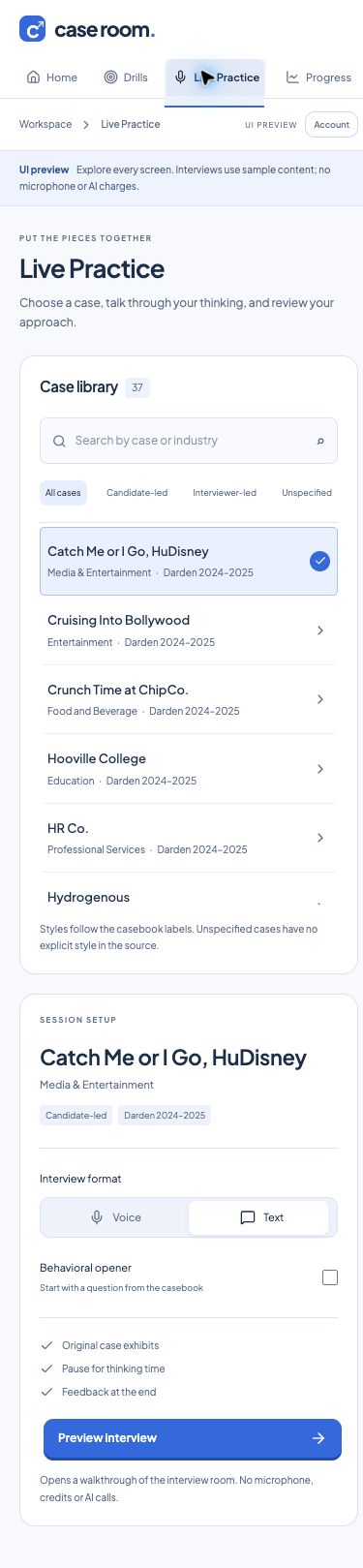
Case Room

A case interview partner, on your schedule.

I wanted to practice consulting interviews out loud without coordinating with a partner. I built a tool for spoken and text interviews, case exhibits, and feedback afterward. I am developing the experience into a hosted product.

One practice sessionIllustrated workflow
01 / Choose

A problem worth thinking through.

Pick a case and a practice format. Give yourself a starting point.

Your next case
Profitability
Market entry
Growth strategy
Voice or text practice
02 / Discuss

Think out loud.
Work the problem.

Ask questions, lay out your approach, and talk through the analysis.

Illustrative conversation
Interviewer

Where would you start?

You

I’d look at revenue and costs.

03 / Explore

Make the information useful.

Bring an exhibit into the discussion and connect it to your reasoning.

A simple way to break it down
Profit
RevenuePrice × Volume
CostsFixed + Variable
Illustrative framework, not casebook content
04 / Reflect

Learn from the reasoning.

Return to the session, review the feedback, and take a clearer approach into the next case.

  1. Choose
  2. Discuss
  3. Explore
  4. Reflect
An illustration of the practice flow. Actual development screenshots below.

What I am working through

The challenge is the interview itself: giving someone room to think, releasing information at the right time, and grounding feedback in what they actually said. I am testing those details before broader use.

TypeScript · React · Node.js · OpenAI

AI / AutomationBuild notes / Public code

Sales Prospect Qualifier

What actually answers after hours?

A phone number tells you how to reach a business. It does not tell you what happens when you call. I built a tool that listens, transcribes the response, and turns it into a classification with evidence attached.

Explore the code
The workflowOne call → a reviewable result
  1. 01Call & listenWait through the greeting.Twilio
  2. 02TranscribeTurn the recording into text.faster-whisper
  3. 03ClassifyIdentify what answered.Claude
  4. 04ReviewKeep the evidence with the label.Human judgment
Illustrative call · no audio

“Please leave a message after the tone.”

The resultVoicemailTranscript + reasoning attached
The recording, transcript, and reasoning stay attached to the result.

A label is only useful if you can check it.

A person, a phone menu, an answering service, and a voicemail can all pick up the same kind of call. The tool distinguishes those outcomes and keeps the source material, so a reviewer can see why it reached a conclusion.

From words to a reviewable result.

The useful output is the label plus its supporting evidence. An unclear answer belongs in the review queue.

Explore an example
What the caller hears
“You have reached our office after hours. Please leave your name and number after the tone, and we will call you back.”
The message asks for a callback.
Classification

Voicemail

Evidence
Leave a message after the tone.
Reasoning
The greeting describes a recording, not a live response.
Evidence attached
What the caller hears
“Our office is closed. For urgent assistance, press one. For all other inquiries, leave a message.”
The recording ends at the menu.
Classification

Needs review

Evidence
An urgent-assistance option is offered.
Uncertainty
The recording does not establish whether that option reaches a person.
Human review required

Illustrative examples written to explain the workflow. These are not customer calls or measured results.

The hard part was knowing when to speak.

Speaking immediately talked over greetings. A fixed delay could miss a long menu. I changed the call flow to wait for speech and then a pause, with another listening pass for hold messages and disclaimers.

First attempt
Business greetingTool speaks too soon
Revised flow
ListenPauseSpeak
Conceptual timing diagram, not a recording. Listen before responding.

Built to be inspected.

I connected the call flow, local transcription, classification, and reporting. Unclear results and classifications below the confidence threshold go to human review. The code is public; the workflow still depends on checking its evidence.

Python · Twilio · faster-whisper · Claude

View the repository
Media / GrowthStrategy, production & distribution

Content Strategy & Growth

Find the hook. Build the story.

I run short-form content for a statewide campaign across TikTok, Instagram, Facebook, and YouTube. The work starts with finding formats that earn attention, understanding why they work, and adapting the structure into new videos.

How a short video comes togetherIllustrated edit
01 / The hook

Start with a reason to care.

The opening gives someone a question they want answered.

OpeningOne clear
question.
Earn the next second.
An illustrated structure, not a campaign clip
02 / The buildup

Give them a reason to stay.

Build the story with context and details that move it toward an answer.

Buildup
ContextA new detailWhat happens next?
Every beat moves the story forward.
03 / The payoff

Deliver what the opening promised.

Close the loop with a clear answer, an outcome, or something useful to take away.

PayoffThe question,
answered.
Make the attention worthwhile.
The story earns the opening.
  1. Hook
  2. Buildup
  3. Payoff
The opening creates interest. The rest of the video has to earn it.
Across the campaign accountsFour platforms
10M+Total video views
25K+Followers
Combined totals across TikTok, Instagram, Facebook, and YouTube. Not a count of unique people.

How I find content worth making

  1. 01

    Find proven formats

    Look for videos already earning attention and collect ideas worth studying.

  2. 02

    Study the hook

    Break down the opening, the question it creates, and the reason to keep watching.

  3. 03

    Adapt the structure

    Build a new video around that structure with a clear story and payoff.

  4. 04

    Review performance

    Use what people watch to decide which formats to repeat and refine.

The next video starts with the last oneA learning cycle
  1. 01Find the ideaStudy a format.
  2. 02Make it yoursBuild the story.
  3. 03PublishPut it in front of people.
  4. 04ReviewLearn what held attention.
Bring what you learn into the next idea.

Content strategy · Video production · Distribution